
Ontario County Criminal Court Cases
Ontario County Court is the ordinary felony trial forum outside New York City. It can also hear misdemeanors tied to a felony matter. The Ontario County Clerk serves as clerk of Supreme and County Courts and keeps their official civil and criminal records. Those files are available through the Clerk at 20 Ontario Street in Canandaigua, while active County Court proceedings take place in the courthouse corridor on North Main Street.
Lower courts keep their own dockets. Canandaigua City Court and Geneva City Court hear misdemeanors, violations, traffic and city matters, arraignments, and early felony proceedings. Town and village Justice Courts do similar local work within their borders. A complete Ontario County court case search therefore starts with jurisdiction. The County Clerk may hold the later felony file but not the whole City Court or Justice Court record that came first.
Ontario County Court's Felony Role
A felony complaint commonly starts in a local criminal court. That court conducts the arraignment, advises the accused of the charge, addresses counsel, and considers release, bail, or remand when allowed. A felony prosecution can then reach Ontario County Court through a grand-jury indictment or a Superior Court Information and waiver process. Reduction or dismissal may keep the matter from moving at all.
This division explains why two docket numbers or court names may appear in the same Ontario County case history. The local docket covers the first phase. The County Court file covers the superior-court prosecution. Search both when the charge began as a felony complaint. The Ontario County Supreme and County Court page shows the clerk's filing and copy routes.
The official Ontario County court source is shown below as a visual reference.
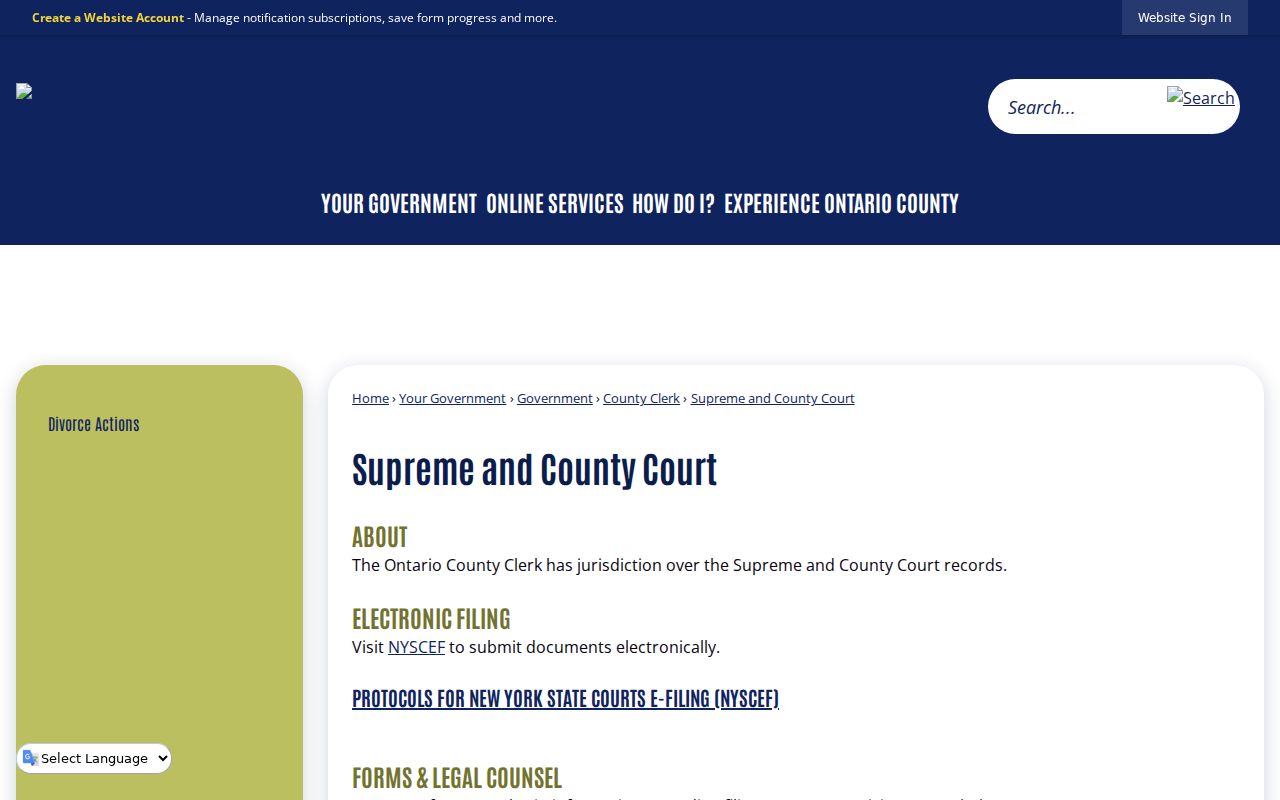
The page helps distinguish the superior-court record office from the separate local courts that may hold the opening docket.
Searching Ontario County Case Records
Use the Ontario County Clerk's IQS index for County and Supreme Court filings, then check New York eCourts/WebCriminal where its coverage reaches the court in question. NYSCEF guest search can help with covered e-filed Supreme Court matters, but it is not a full Ontario County criminal docket. When no public screen returns the case, contact the clerk of the city, town, or village court that handled it. Ask by defendant name, case or docket number if known, approximate filing or arrest date, and charge. State whether inspection, a plain copy, a certified copy, or a certificate of disposition is needed.
- Open the official Ontario County online record search instructions and enter IQS as a guest.
- Choose General Criteria, then set Search Type to Civil / Criminal Case Name. The separate Name Index option leads to other record categories.
- Enter the name in Last First Middle order. Add a recorded-date range only when it will not hide an older filing.
- Compare the result with New York eCourts/WebCriminal and note that local-court coverage is uneven.
- Request the needed paper or certified record from the correct clerk. The Ontario County Clerk does not accept phone searches or phone copy requests.
| Field label | Type | Required | Notes |
|---|---|---|---|
| Login | Account mode | Yes | County instructions direct the public to Guest; paid access choices also appear. |
| Search Type | Selection | Yes | Under General Criteria, use Civil / Criminal Case Name; Name Index covers other record categories. |
| Name | Text | Practical requirement | Enter Last First Middle; business-name searching is also supported. |
| Recorded Date | Date range | No | Leave blank to search all dates or use MM/DD/YYYY. |
| Document Types | Checklist | No | Search all types or expand the list to narrow it. |
The county IQS instructions are the source for the interface shown next.
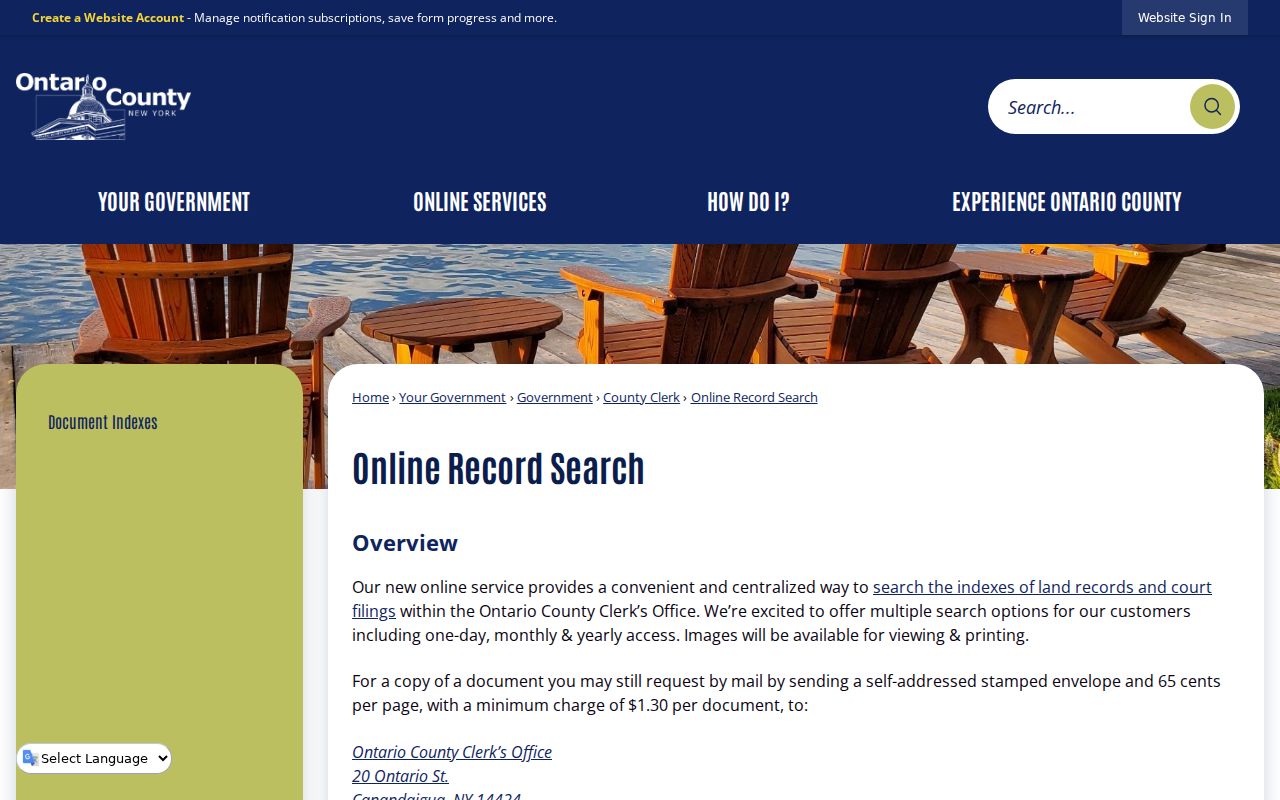
Its field layout makes a broad name search useful, but a result is an index lead rather than the full Ontario County criminal case file.
Which Ontario County Court Holds It?
Start with the court named on the ticket, appearance notice, accusatory instrument, or prior docket entry. Canandaigua and Geneva City Courts control their own city criminal files. Each town or village Justice Court controls its local docket. Ontario County Court controls the ordinary felony prosecution after superior-court transfer. The New York courts' Ontario County directory is the sound way to confirm current clerk contacts.
A Geneva or Canandaigua case may never become a County Court case. A misdemeanor can remain in City Court from arraignment through disposition. The same is true in a Justice Court. An empty County Clerk search is not proof that no case exists. It may only mean the matter stayed in a lower court, used a different name form, fell outside electronic coverage, or was sealed.
Note: Ask the named local clerk before treating an empty county index or WebCriminal result as a final answer.
Inside an Ontario County Case File
An Ontario County court file is event-centered. It records what was filed and what the judge did, not every detail in a police report or jail booking. Filed charges may differ from arrest charges because prosecutors can amend, reduce, dismiss, supersede, or replace them through indictment. Read the docket in date order and match each charge to its own outcome.
| Case number and court | Identifies the docket and the clerk responsible for the official file. |
|---|---|
| Accusatory instrument | Shows the complaint, information, felony complaint, or indictment used to allege the offense. |
| Docket entries | Lists appearances, counsel, motions, conferences, hearings, warrants, and orders in sequence. |
| Charge details | May show the offense, Penal Law or Vehicle and Traffic Law citation, and charge status. |
| Disposition | States the recorded result, such as conviction, dismissal, acquittal, or another resolved status. |
| Sentence | Records the court's sentence and may identify probation, custody, restitution, or related conditions. |
Victim names, precise personal identifiers, sealed counts, confidential discovery, and grand-jury minutes are not part of an ordinary public display. A public screen may also omit the filed document itself even when a clerk copy can lawfully be obtained.
Ontario County Disposition Proof
A certificate of disposition comes from the originating court and provides certified proof of the outcome in that case. It is not the same as the Office of Court Administration's Criminal History Record Search. OCA CHRS is a statewide exact-name-and-date-of-birth search of covered public pending and conviction records. It costs $95 for each name, alias, or date-of-birth variation, and it is not fingerprint based or certified.
CHRS omits sealed cases, violations and infractions, Family Court transfers, pardoned matters, certain older single misdemeanors, and some cases with missing dispositions. A spelling or birth-date mismatch can also cause a false negative. Use OCA CHRS when its broad court-history product fits the need. Use the Ontario County or local court clerk when the goal is a certified outcome from one known docket.
How a Criminal Case Moves
The accusatory instrument starts the court record. Arraignment follows, with a plea and decisions about counsel and release. Felony preliminary work occurs in local court before indictment or a Superior Court Information can move the prosecution to Ontario County Court. Discovery, motion practice, conferences, and hearings build the middle of the docket. A plea, dismissal, or trial resolves the merits, but a verdict and sentencing are separate events.
Case flow: Charges Filed › Arraignment › Pretrial › Plea or Trial › Disposition › Sentencing
Appeals, resentencing, probation violations, and sealing orders can add entries after sentence. The final event visible today may not be the case's last event. For broader context on the difference between filing and custody records, the Ontario County arrest lookup explains the separate arrest paper trail.
Justice Navigator Court Connections
Ontario County's Justice Navigator Program can connect voluntary participants with Drug Court, Mental Health Court, treatment, and community services. At a participant's request, a navigator may attend court or probation appointments and help explain process. The program cannot give legal advice, influence a judge, perform a competency evaluation, or act as the diversion court itself.
Treatment-court participation can place status, compliance, or appearance events on a docket without making private treatment notes public. The Ontario County Public Defender represents qualifying people in County Court, the two City Courts, Justice Courts, Drug Court, appeals, and certain supervision matters. The official Public Defender source appears below.
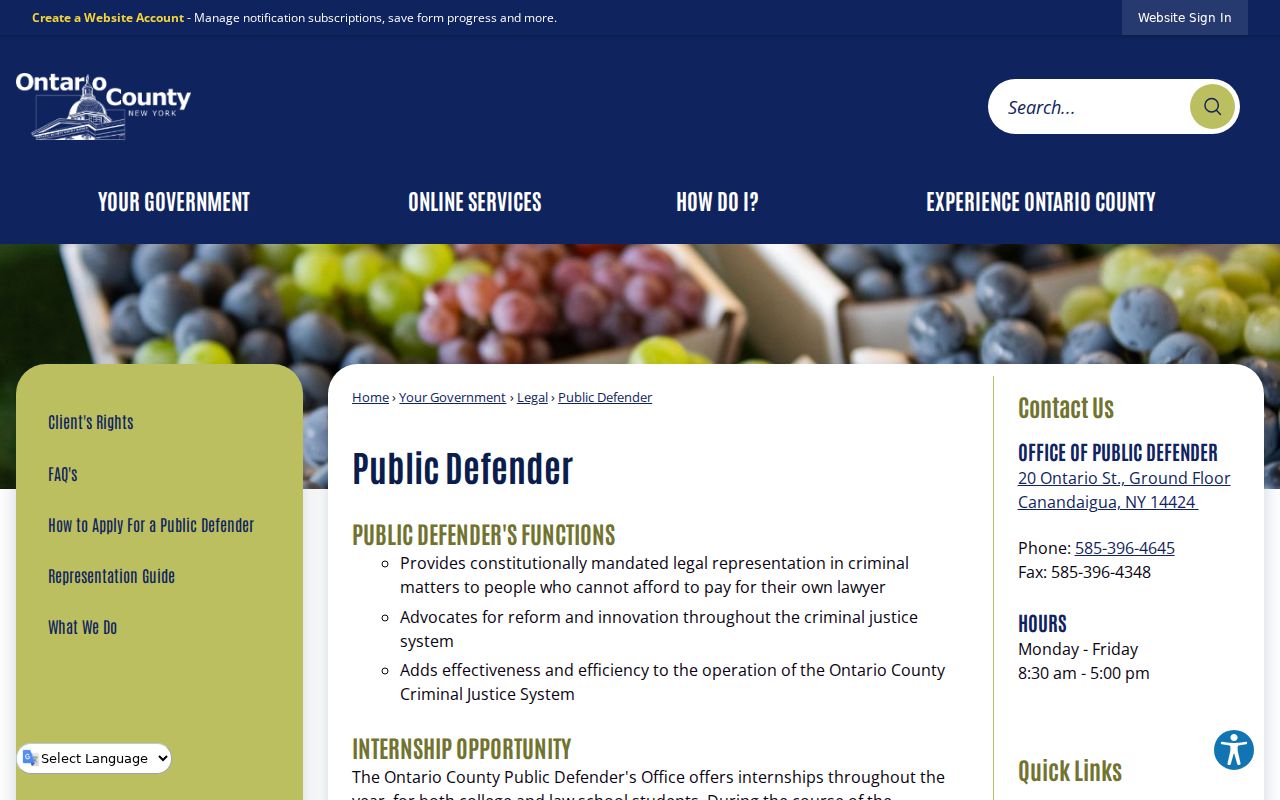
That office can interpret its client's court papers, while the neutral certified record still comes from the clerk who holds the case.
Case Record Access & Restrictions
New York Freedom of Information Law governs executive-agency records, but it is not the route for judicial case files. Judiciary Law §255 governs a clerk's search and copy duties for records of courts of record. Ask a police agency under FOIL for its report. Ask the court clerk for the docket, filed case documents, and certified disposition.
Sealed cases, youthful-offender matters, juvenile material, grand-jury records, victim information, and confidential discovery can be hidden, redacted, or withheld. Under CPL 160.50, a case ending in the accused's favor is generally sealed subject to statutory exceptions. A clerk may confirm that no public record can be provided without disclosing protected content.
Ontario County Court Copies
The Ontario County Clerk does not perform phone searches and does not accept copy requests by phone. IQS-located documents requested by mail require a self-addressed stamped envelope. The online instructions list $0.65 per page with a $1.30 minimum per document. A separate Supreme and County Court schedule lists certified copies at $1.25 per page with a $5 minimum, a $5 clerk certificate, and $15 exemplification. Confirm which schedule and payee apply before sending funds.
Ontario County Clerk
20 Ontario Street
Canandaigua, NY 14424
585-396-4451
Records and Archives Center
3051 County Complex Drive
Canandaigua, NY 14424
Appointment required for archive visits
Inactive Ontario County records remain under the ownership and access authority of the department that created them. Historical County Court holdings date to 1793, with most material from 1847 through 1942. An archive appointment and permission from the originating office may both be needed.